Abstract
-
MIPS instructions are 4 bytes in size.
-
However, memory addresses are also 4 bytes long, which means a single instruction is not enough to directly load a full memory address.
-
In MIPS, memory addresses are typically computed using two approaches:
thelui + addiumethod and the$gpmethod.
Addressing Methods in MIPS
The lui + addiu Method
-
This method uses two instructions—
luiandaddiu—to construct a memory address. -
Example instructions:
 1
 2
 3
 4
 5
 6
 7
 8
 9
10
# MIPS big endian lui $a0, 0x0000 3c 04 00 00 addiu $a0, 0x0000 24 84 00 00 # MIPS little endian lui $a0, 0x0000 00 00 04 3c addiu $a0, 0x0000 00 00 84 24 # lui : loads the operand shifted left by 16 bits # addiu : adds the operand (immediate addition, unsigned)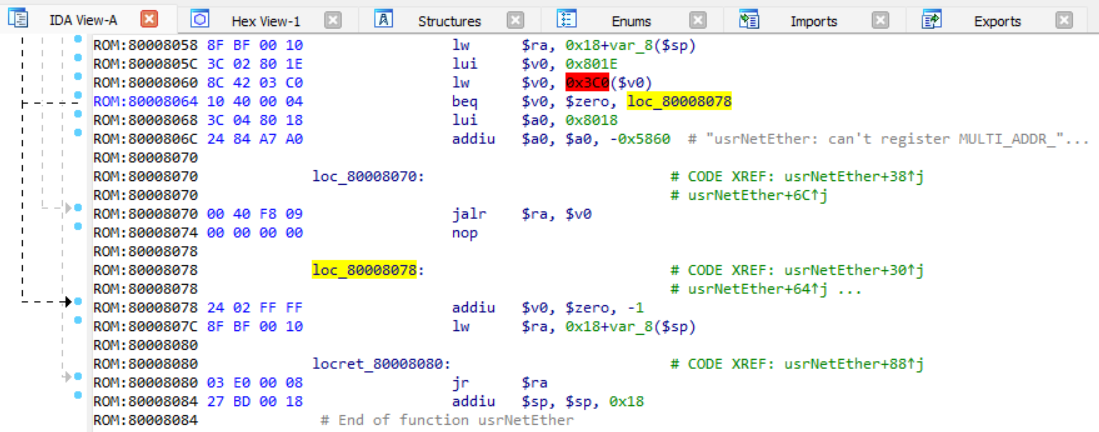
-
The
$a0register stores the first function argument. -
From
$a0to$a3, a total of four argument registers exist, and all of them can be used for address calculation. -
To check whether a program uses the
lui + addiumethod, you can search for the corresponding instruction patterns in the binary:1 2 3 4 5# MIPS big endian hexdump -C firm.bin | grep "3c 04 .. .. 24 84 .. .." --colour # MIPS little endian hexdump -C firm.bin | grep ".. .. 04 3c .. .. 84 24" --colour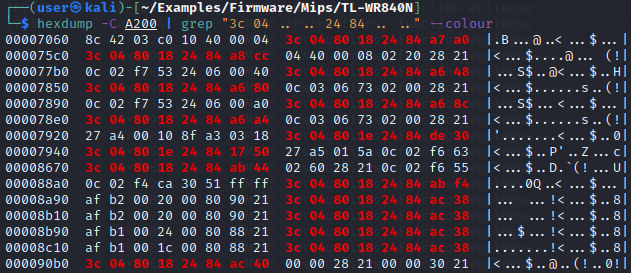
The $gp Method
-
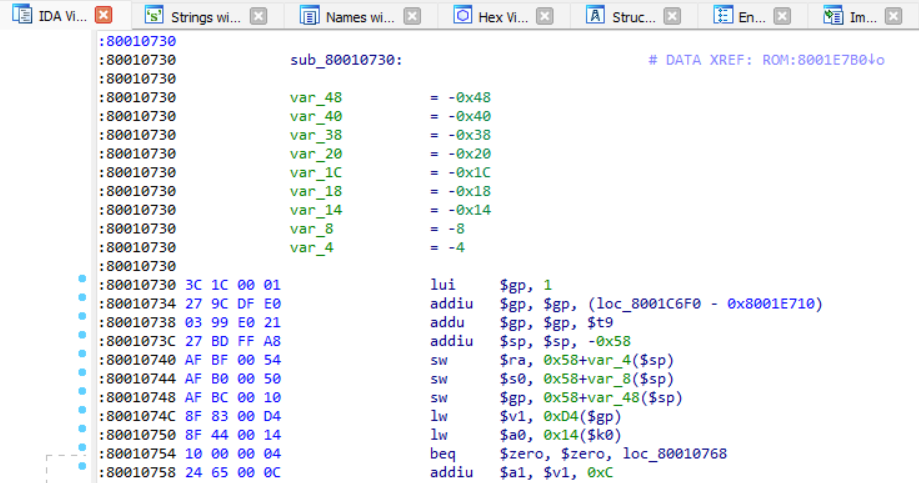
$gpis the Global Pointer register. -
Within a program, all
$gpreferences point to the same memory region. -
This region contains addresses that are referenced by the program.
-
To compute the global pointer, instructions like the following are used:
1 2 3 4 5 6 7 8 9 10 11 12 13# MIPS big endian lui $gp, 0x0000 3c 1c 00 00 addiu $gp, 0x0000 27 9c 00 00 addu $gp, $t9 03 09 e0 21 # MIPS little endian lui $gp, 0x0000 00 00 1c 3c addiu $gp, 0x0000 00 00 9c 27 addu $gp, $t9 21 e0 09 03 # lui : loads the operand shifted left by 16 bits # addiu : adds the operand (immediate addition, unsigned) # addu : adds register values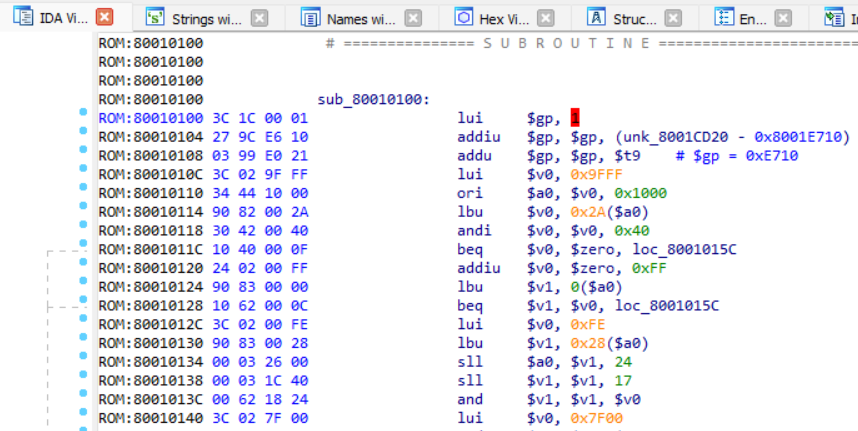
-
The
$t9register holds the current function entry point address. -
Memory accesses are then computed as an offset from
$gp.
-
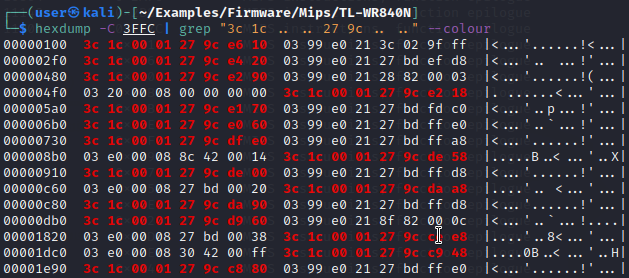
To check whether a program uses the
$gpmethod, search for the$gpinitialization sequence:1 2 3 4 5# MIPS big endian hexdump -C firm.bin | grep "3c 1c .. .. 27 9c .. .." --colour # MIPS little endian hexdump -C firm.bin | grep ".. .. 1c 3c .. .. 9c 27" --colour